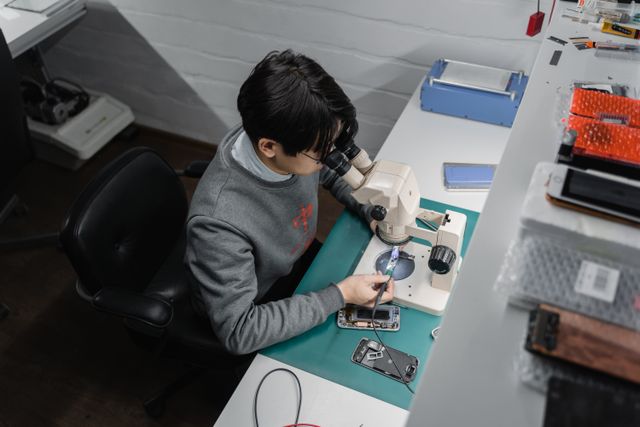
A customer walks into a repair shop with a device that will not charge. The obvious suspect might be the charging port, but the actual cause could involve the battery, cable connection, internal circuitry, software, or previous physical damage. Finding the problem efficiently is often the difference between a smooth repair and hours of unnecessary troubleshooting.
That is where artificial intelligence is becoming increasingly useful. AI tools can help repair businesses organize diagnostic information, recognize recurring fault patterns, manage workloads, forecast parts requirements, and improve customer communication. For businesses providing tech device repair services, these capabilities can support technicians without removing the human expertise required to perform reliable repairs.
The real opportunity is not to automate every task. It is to reduce the amount of time employees spend searching, sorting, estimating, and performing repetitive administrative work so they can focus on diagnosis, repair quality, and customer service.
AI Can Make the Diagnostic Process More Focused
Diagnosis is often one of the most time-consuming stages of device repair because similar symptoms can have very different causes. A device that shuts down unexpectedly, for example, could have problems related to power, temperature, hardware, software, or several interacting factors.
AI-assisted diagnostic tools can analyze symptoms, error information, repair histories, test results, and known failure patterns to suggest possible causes. Instead of replacing a technician’s diagnosis, the system can help narrow the search.
This is particularly useful when a repair business has accumulated substantial historical information. If hundreds of previous jobs show that a particular combination of symptoms frequently leads to the same type of failure, AI can identify that relationship much faster than a technician manually reviewing old records.
The technician still needs to verify the problem through appropriate testing. AI can suggest where to look; professional judgment determines whether the suggestion is correct.
Past Repairs Can Become a Useful Knowledge Base
Repair businesses generate valuable information every day, but much of it disappears into completed job records.
Each repair can contain information about the original complaint, diagnostic findings, components replaced, labor time, unsuccessful attempts, final solution, and whether the customer later returned with another problem.
AI can help organize this history into searchable knowledge.
Imagine a technician encountering an unusual fault. Instead of relying entirely on memory, the technician could search previous cases for similar symptoms and see which diagnostic paths produced successful outcomes.
Over time, this can create an internal knowledge base that becomes more useful as additional repairs are completed.
It can also help newer technicians learn from the experience of senior employees. Knowledge that would otherwise remain with individual team members becomes easier to share across the business.
Better Triage Can Reduce Unnecessary Waiting
Not every repair needs the same level of attention. Some devices require a quick inspection or straightforward component replacement, while others need extensive diagnostics.
AI can help categorize incoming jobs based on reported symptoms, expected complexity, urgency, parts availability, and estimated repair time.
Better triage makes scheduling more intelligent. A simple job does not necessarily need to sit behind several complicated repairs if it can be completed quickly without disrupting other commitments.
Likewise, a device that requires a component that is currently unavailable can be identified early rather than occupying valuable diagnostic capacity.
The goal is not simply to move easy jobs ahead of difficult ones. It is to understand what each repair requires before assigning resources, allowing managers to create a workflow that keeps technicians productive.
AI Can Help Predict Repair Times More Realistically
Customers naturally want to know when their device will be ready. Unfortunately, estimating completion time can be difficult when technicians are balancing multiple repairs.
Simple estimates may ignore the current workload, technician availability, diagnostic complexity, parts delivery, and the probability that additional issues will be discovered.
AI-supported scheduling can analyze historical completion times for similar repairs along with current operational conditions. That can help businesses create more realistic estimates.
For example, if a certain type of repair typically takes longer than expected because it frequently requires additional diagnostics, historical data can influence future scheduling.
More accurate estimates benefit everyone. Technicians face less pressure from unrealistic deadlines, managers can plan capacity more effectively, and customers receive expectations that are more likely to match the actual repair process.
Parts Management Can Become More Predictive
Replacement components create a difficult inventory problem for repair businesses. Holding too much stock ties up money, while holding too little can delay repairs.
AI can analyze historical usage to identify which components are consistently required and which are rarely used. Demand patterns can then inform purchasing decisions.
Seasonality may also matter. If certain types of damage or repair requests increase during particular periods, inventory requirements can potentially be adjusted before demand rises.
The same approach can identify slow-moving stock. Components that have remained unused for long periods represent capital and storage space that might be better allocated elsewhere.
Predictive inventory planning does not eliminate uncertainty, especially when new device types or unexpected failures appear. It can, however, provide a stronger basis for deciding which commonly required components should be readily available.
Image Analysis Can Support Visual Inspection
Visual inspection is another area where AI may support technicians. Computer vision systems can analyze images and potentially help identify visible damage patterns such as cracks, corrosion, deformation, or other abnormalities.
This can be useful for documenting the condition of a device during intake. Images captured when the customer hands over the device create a clearer record of visible condition before repair work begins.
AI-supported comparison may also help highlight areas that deserve closer examination.

However, visual recognition has important limitations. Damage that appears similar on the surface can have very different internal consequences. A system might identify an unusual visual feature without determining the actual technical cause.
For this reason, image analysis should be treated as another diagnostic input rather than proof of a specific fault. Physical inspection and technical testing remain essential.
AI Can Help Technicians Find Information Faster
Modern electronics can involve complicated assemblies, diagnostic procedures, connectors, components, and software interactions. Technicians may need to consult documentation or internal repair notes while troubleshooting.
Finding the right information can consume valuable time.
AI-powered search can make technical knowledge easier to retrieve by allowing technicians to ask questions in natural language rather than manually searching through large collections of documents.
The quality of the underlying information is critical. An AI-generated answer based on inaccurate or incomplete material can send a repair in the wrong direction.
Repair businesses should therefore treat AI-generated technical guidance as information that needs verification. Reliable documentation, experienced technicians, and proper testing should remain the authority when making repair decisions.
Used carefully, AI can shorten the search process without lowering the standard of technical judgment.
Customer Communication Can Become Easier to Manage
Repair teams often spend a surprising amount of time answering repetitive questions. Customers want to know whether diagnosis is complete, whether a part has arrived, how much longer the repair will take, or whether their device is ready.
AI-assisted communication can reduce some of this administrative workload.
Status information from the repair workflow can be converted into clear customer updates. Routine questions can be handled automatically when the answer is already available in the job record, while unusual or sensitive issues can be escalated to an employee.
AI can also help translate highly technical repair information into language that customers can understand. A technician may document a complex electrical or hardware problem, while the customer primarily needs a clear explanation of what failed, what needs to be done, and what the repair involves.
Automation should not eliminate human communication. Customers still need access to knowledgeable staff when decisions, unexpected costs, or complicated technical issues require discussion.
Smarter Scheduling Can Improve Technician Productivity
Technician time is one of the most valuable resources in a repair business. Poor scheduling can waste it quickly.
One employee may become overloaded with complex repairs while another has available capacity. A technician might begin a job only to discover that a required component has not arrived. Another repair may remain untouched even though everything needed to complete it is available.
AI-assisted scheduling can consider technician skills, job complexity, expected repair duration, parts availability, priority, and current workload together.
This can help managers decide which technician should receive which job and when work should begin.
The system can also respond when circumstances change. If a repair takes longer than expected or a component delivery is delayed, other jobs can potentially be reorganized instead of allowing the original schedule to create unnecessary downtime.
Quality Control Can Become More Consistent
Repair quality depends not only on fixing the original problem but also on ensuring that the device works properly before it is returned.
AI can support quality assurance by helping businesses standardize post-repair checks according to the work performed. Different repairs may trigger different testing requirements.
The system can also examine return and rework data. If a particular repair category produces an unusually high number of repeat visits, managers can investigate whether there is a recurring diagnostic, component, or process issue.
This turns quality control into a learning process.
Instead of treating every repeat repair as an isolated incident, businesses can look for patterns across hundreds of completed jobs. Correcting one underlying process problem could potentially prevent many future returns.
AI Can Help Managers Understand What Is Slowing the Business Down
A busy repair shop can appear productive simply because every technician is occupied. Activity, however, is not the same as efficiency.
AI-based analysis can help managers identify where jobs spend the most time. Devices may be waiting for diagnosis, customer approval, replacement components, technician availability, testing, or collection.
Finding these bottlenecks changes how efficiency problems are addressed.
If most delays occur while waiting for parts, pushing technicians to work faster will accomplish very little. If diagnosis is the main bottleneck, better knowledge access or triage may produce greater improvement. If repaired devices spend excessive time waiting for final testing, quality-control capacity may need attention.
AI is particularly useful for finding patterns that are difficult to see when managers are concentrating on individual jobs.
Data Privacy and Security Need Serious Attention
AI adoption also introduces responsibilities, particularly when repair records contain customer information.
Businesses should be careful about what information is entered into AI systems, where that data is processed, how long it is retained, and who can access it. Customer data should not be exposed unnecessarily simply because an AI tool makes a workflow more convenient.
Access controls and clear internal policies become important. Employees should understand which information can be processed through approved systems and which information requires additional protection.
The same caution applies to customer devices. Repair businesses may encounter personal photographs, messages, accounts, documents, and other sensitive information during legitimate repair work.
Efficiency should never come at the expense of privacy. AI tools need to operate within the same professional responsibility to protect customer information that applies to the rest of the repair process.
The Best Model Combines AI With Skilled Technicians
AI can process large quantities of information quickly, identify patterns, generate suggestions, and automate repetitive tasks. What it cannot reliably replace is the practical judgment developed through hands-on repair experience.
A technician can notice unusual physical damage, question an inconsistent diagnostic result, understand the implications of a previous repair, and recognize when a suggested solution simply does not make sense.
That makes human-AI collaboration more useful than complete automation.
AI can narrow possible faults, retrieve relevant information, organize schedules, predict component demand, and highlight unusual patterns. Technicians can verify those recommendations, perform physical diagnostics, complete the repair, and make final quality decisions.
Each side handles the work it is better suited to perform.
From Faster Repairs to a Smarter Repair Operation
The most valuable impact of AI may not be a dramatic new repair technique. It may be the gradual removal of dozens of small inefficiencies that currently slow device repair businesses down.
Faster access to repair knowledge can shorten diagnosis. Better triage can prevent jobs from sitting unnecessarily. Predictive parts planning can reduce delays, while smarter scheduling can keep technicians working on jobs that are actually ready to progress. Automated updates can reduce repetitive customer inquiries, and analysis of repeat repairs can strengthen quality control.
Together, these improvements can make the entire operation easier to manage.
AI should not turn device repair into a process where software makes every decision. Electronics remain complex, failures can be unpredictable, and customers need skilled professionals who can recognize when the obvious answer is not the correct one.
The stronger approach is to use AI where it adds clarity and speed while keeping experienced technicians responsible for technical judgment and repair quality. When that balance is achieved, AI can help repair businesses do more than complete jobs faster. It can create a more organized, consistent, accurate, and customer-friendly repair operation.
Leave a Reply